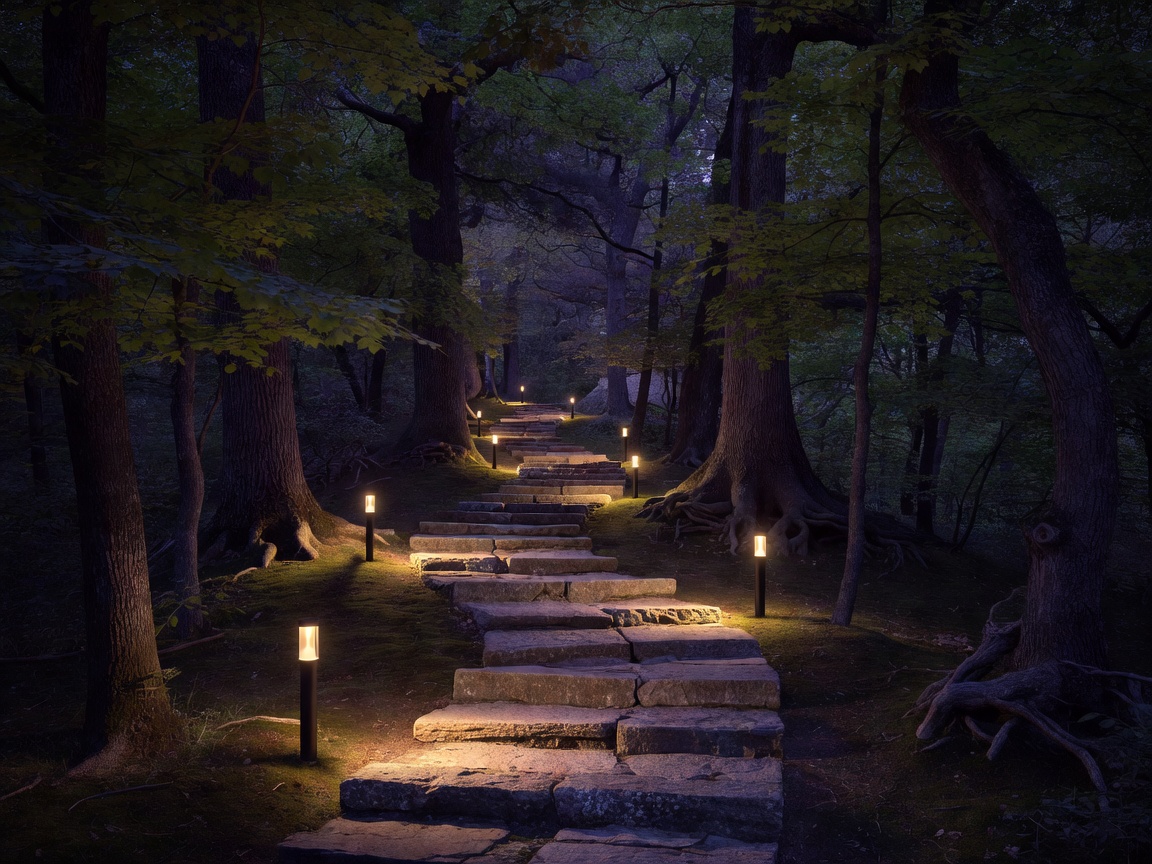
Amateur landscape illumination frequently makes the error of over-lighting: blinding high-Kelvin floodlights that resemble industrial security yards. Elite landscape lighting is an exercise in subtle darkness, gentle shadows, and low-contrast warm white color rendering (CRI 90+ at 2700K).
1. The Four Core Lighting Techniques
- Moonlighting: Mounting soft 3W 60-degree beam fixtures high within the mature canopy of deciduous trees (25 to 35 feet) angled downwards through the branches. This creates naturalistic dappled leaf shadows across lawns and stone terraces.
- Wall Grazing: Placing narrow-beam spot fixtures 6 to 8 inches away from rough masonry or stacked stone walls to cast dramatic vertical relief shadows across stone texture.
- Silhouetting: Concealing an uplight fixture behind an architectural specimen plant (such as a Japanese Maple) aimed at a flat pale backdrop wall, rendering the plant in pure architectural silhouette.
- Subtle Step & Under-Cap Lighting: Concealed LED brass light strips mounted beneath hardscape wall caps and stair treads, washing the walking surface while hiding the light source entirely from the human eye.
2. Electrical Physics: Voltage Drop Mitigation
In low-voltage 12V AC systems, running lengthy cable lines causes resistance voltage loss. If a fixture receives under 10.5V, LED output flickers or exhibits color shifts toward cold blue.
To eliminate this, use the Hub & T-Methodology rather than a long daisy chain. Run a heavy 10/2 AWG main trunk from the transformer to a weatherproof underground junction box located in the center of the planting bed, then distribute short 12/2 runs outward to individual fixtures.
3. Solid Cast Brass Fixture Longevity
Avoid aluminum powder-coated fixtures in exterior soil beds, as fertilizers and moisture inevitably oxidize the coating within three years. Heavy cast brass or copper develops an organic verdigris patina, remaining completely impervious to soil chemistry for decades.